History of the United Nations Association Estonia
The roots of the United Nations Association Estonia date back to 30 April 1994, when a voluntary association was established to introduce the work of the UN in Estonia and promote discussion about the organisation’s goals and international cooperation. Its founders were mainly lecturers and students from the Faculty of Social Sciences at the University of Tartu, and all activities relied on voluntary contributions.
1994–2009
From a Voluntary Association to an Educational Organisation
Following legal changes concerning non-profit organisations, the association was re-established in Tartu on 18 March 2000 as the Estonian United Nations Association. The renewed organisation aimed to support Estonia’s participation in the UN system and promote UN values—democracy, human rights, the peaceful resolution of conflicts, environmental protection and civil society—in Estonia. Its membership consisted mainly of university students and young volunteers.
In the early 2000s, the Estonian United Nations Association developed into an active educational organisation.
The organisation held lecture series, essay competitions, information days, youth projects and UN simulations. Simulations for upper-secondary school and university students were particularly important, introducing participants to UN decision-making processes and international relations. Participants represented different UN Member States and discussed topics such as international terrorism, human rights, integration and gender equality. By 2007, the organisation had grown to nearly two hundred members and was holding multi-day simulations at the University of Tartu Library.
Following a period of active development, the organisation’s activities declined in 2008–2009. At the same time, a new generation of Model UN organisers began to emerge in Tallinn, gradually shifting the organisation’s centre of activity from Tartu to Tallinn.
2010–2020
A Decade of Change
During the 2010s, the organisation focused on public lectures, discussions and school visits concerning international relations. In cooperation with the Estonian Ministry of Foreign Affairs, the European Commission Representation in Estonia and international partners, lectures were held on international law, cybersecurity, the International Criminal Court and the UN’s role in global conflicts. The organisation also participated in the Back to School programme to introduce Estonian students to the work of the UN and Estonia’s role in international cooperation. During this period, Tallinn Model United Nations and the Estonian United Nations Association also organised a public lecture by UN Secretary-General Ban Ki-moon in Tallinn.
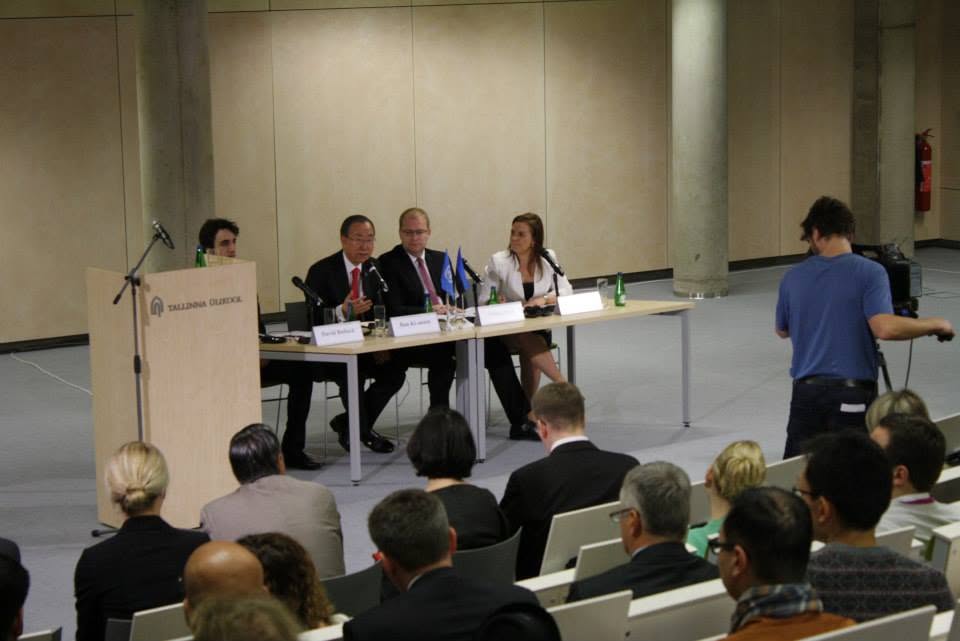
UN Secretary-General Ban Ki-moon’s Visit to Estonia in 2013
In 2016, the Estonian United Nations Association officially ceased operations. Although the organisation was legally dissolved, informal activities continued, and a community remained that wished to keep raising awareness of UN-related topics in Estonia.
2020-2024
A New Beginning
A new chapter began on 30 June 2020, when University of Tartu lecturer Thomas Michael Linsenmaier, Baltic Studies Institute analyst Mart Veliste and Estonia’s first Special Representative for Human Rights and Migration, Minna-Liina Lind, re-established the organisation under the name United Nations Association Estonia. After a four-year pause, this gave Estonia’s United Nations Association movement a new legal and organisational foundation.
Activities were more modest during the first years, partly because of the COVID-19 pandemic, but important organisational development took place at the same time. A new website and visual identity were created, communication channels were restored, the governance structure was developed, and new partnerships were formed with Estonian public institutions and international organisations. Public discussions and cooperative projects were also resumed.
Activities were more modest during the first years, partly because of the COVID-19 pandemic, but important organisational development took place at the same time. A new website and visual identity were created, communication channels were restored, the governance structure was developed, and new partnerships were formed with Estonian public institutions and international organisations. Public discussions and cooperative projects were also resumed.
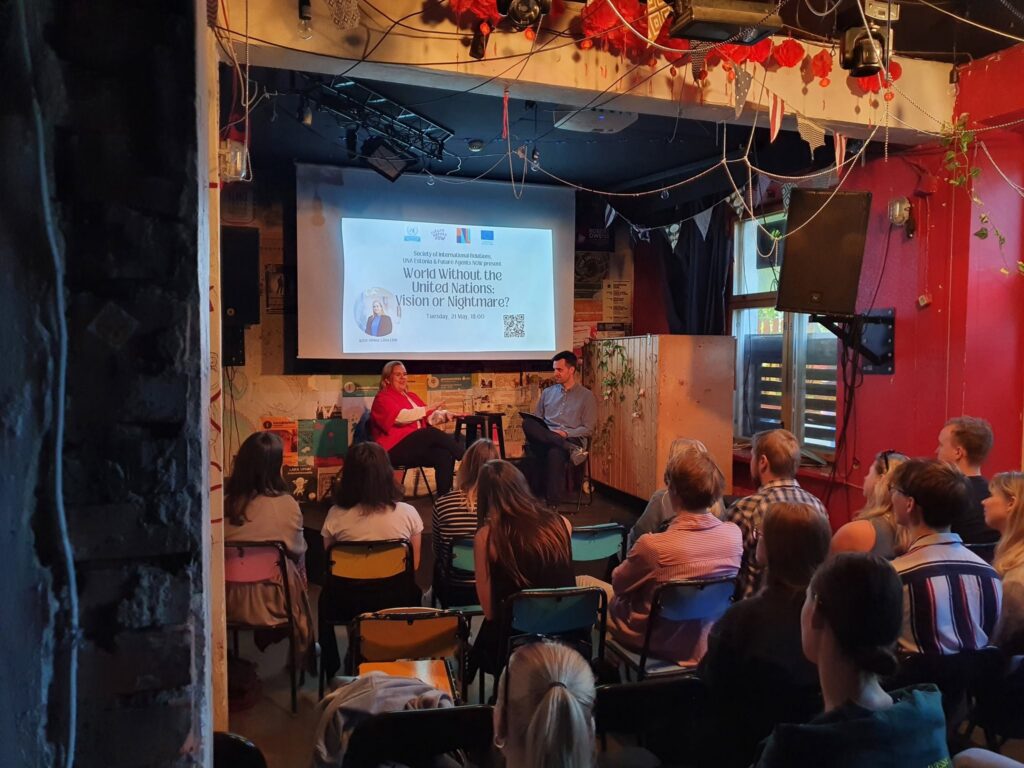
The “World without the UN: Vision or Nightmare?” Discussion at Genialistide Klubi on 21 May 2024
Thomas Michael Linsenmaier made an important contribution to reviving and developing the association. His work and that of the other leaders at the time helped restore the organisation’s continuity and create a foundation from which new initiatives, projects and a more active membership could later grow. The period that began in 2020 therefore laid the groundwork for the United Nations Association Estonia as it operates today.
2024–PRESENT
A New Youth-Led Chapter
From 2024 onwards, the organisation’s activities expanded considerably when three young people—Alexander Reinola, Bogdan Janakov and Sebastian Rock—joined the association. Public discussions were organised in cooperation with universities and other civil society organisations, and collaboration with the Estonian Ministry of Foreign Affairs increased. The following year, Bogdan Janakov and Sebastian Rock launched the youth participation project NextGenUN with support from the Erasmus+ programme. The project aimed to introduce young people to the work of the UN, international cooperation and civic participation. It included youth conferences, school visits and the Tartu Model UN simulation, reaching more than 600 young people.
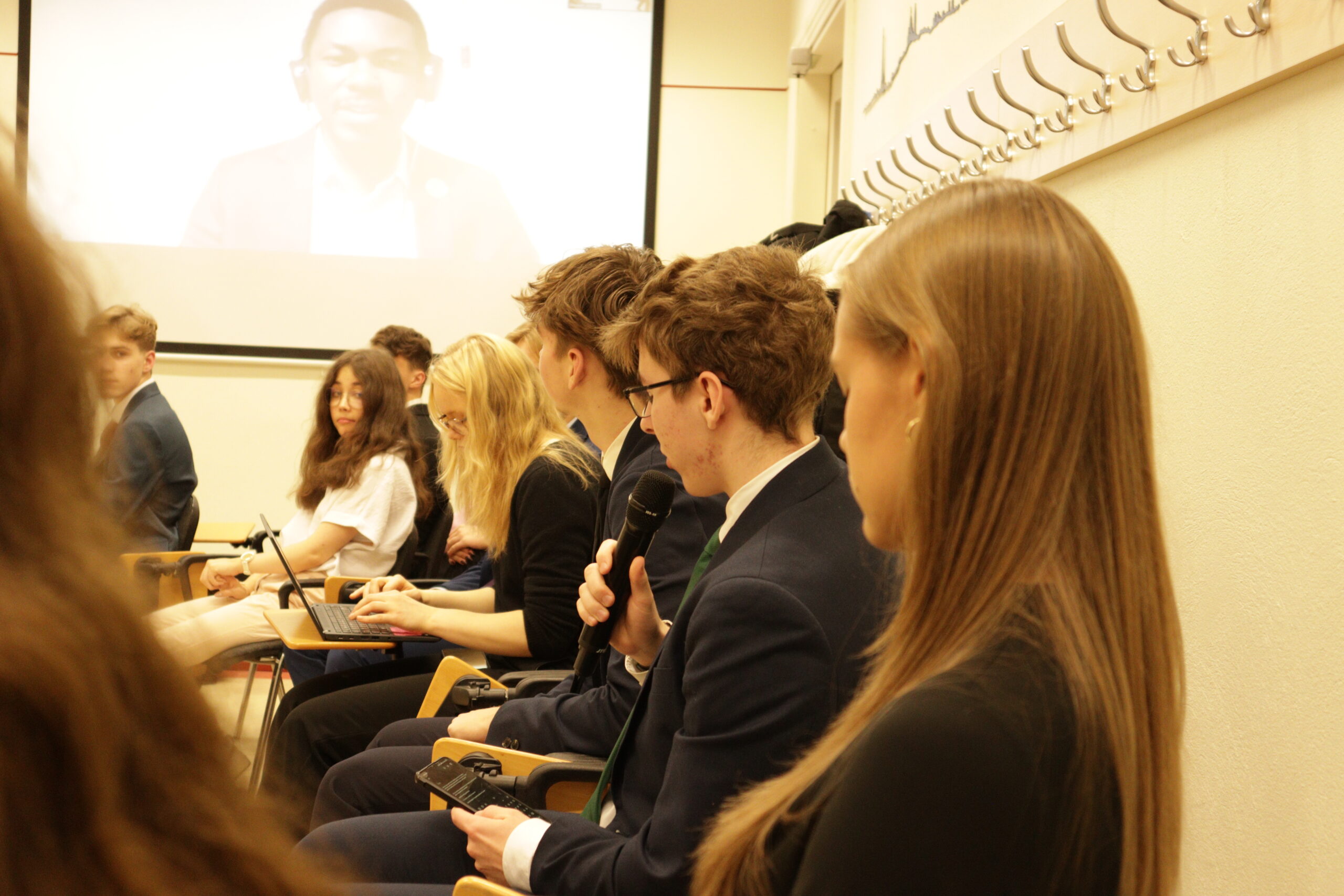
Tartu Model UN, 5–8 December 2025
In 2025, raising public awareness in Estonia about international issues also became one of the organisation’s principal areas of activity. The organisation held a panel discussion on the UN and multilateral cooperation at the Opinion Festival, organised several public conferences, and developed Estonian-language educational content about the UN for its website and social media channels.
At the end of the same year, the Young Diplomats Programme was launched to prepare young people from Estonia to participate in World Model United Nations (WIMUN), the world’s largest UN simulation, in New York. The programme combines preparatory training for the international simulation, meetings with Estonian diplomats and experts, and scholarship opportunities to make the international experience accessible to as many young people as possible. The first delegation participated in WIMUN in February 2026 and met both Estonian diplomats and UN representatives during its visit to New York.
Today, the United Nations Association Estonia is a non-profit organisation that supports and promotes the involvement of Estonian civil society in the work of the UN and related issues. Our activities cover many areas of the UN’s work, including peace and security, disarmament, sustainable development and human rights, as well as emerging topics such as migration, climate and the environment.
Our work is dedicated to the benefit of Estonia and Estonian society. We are inspired by a belief in the value of an active civil society and its ability to help shape a stronger Estonia and a stronger UN.
We are independent and are not affiliated with any political party. Our work is guided by the values and principles set out in the UN Charter and endorsed by all Member States. We also follow the Code of Ethics for Estonian Non-profit Organisations.
The Association organises educational programmes, UN simulations and public discussions, and promotes international cooperation. We work with the Estonian Ministry of Foreign Affairs, UN organisations, Nordic United Nations Associations, universities and other partners.